The Ultimate Guide to Social Media Lead Generation for Navi Mumbai Small Businesses: A Strategic Blueprint
Ekira Marketing | Posted on |
The Best 5 Ultimate Guide to Social Media Lead Generation for Navi Mumbai Small Businesses: A Strategic Blueprint
The business landscape of Navi Mumbai has undergone a radical transformation, evolving from a residential satellite town into a powerhouse of commercial activity and technological innovation. For small businesses operating within this planned city, the shift toward a digital-first economy is no longer a distant prospect but a present reality.
By 2026, the city has firmly established its own identity, independent of Mumbai, driven by infrastructure like the Mumbai Trans Harbour Link and the upcoming Navi Mumbai International Airport. This growth demands a sophisticated approach to digital marketing services that acknowledges the unique geography and demographic profile of the region, stretching from the bustling retail hubs of Vashi to the professional corridors of Airoli and the emerging residential expanses of Panvel.
Effective lead generation through social media platforms has become the primary growth engine for local enterprises, with 83% of Indian small and medium enterprises reporting that social media is a key driver for sales. The maturity of the digital ecosystem in 2026 means businesses are no longer competing only for likes, followers, or visibility on social media—they are competing for qualified leads that convert into measurable revenue.
With over 1 billion internet users in India and social media identities exceeding 500 million, the opportunity for hyper-local market dominance has never been greater. This report provides a comprehensive analysis of the strategies, tools, and local nuances required for Navi Mumbai small businesses to thrive using expert-led social media marketing.
Understanding the Navi Mumbai Digital Ecosystem in 2026
The demographic profile of Navi Mumbai is distinct from its neighbors, characterized by a younger, tech-savvy population and a highly organized urban layout. The city’s structure, divided into specific functional nodes, dictates how digital marketing services should be deployed. While Vashi serves as the established retail and educational center, Airoli and Mahape act as the technological heart of the region, housing massive IT parks like Mindspace and Millennium Business Park. Panvel and Kharghar represent the growth frontier, attracting a mix of young professionals and families.
By 2026, consumer behavior in Navi Mumbai has shifted toward social commerce and visual discovery. Research indicates that 46% of Gen Z users now prefer social media apps over traditional search engines for discovering brands, products, and local businesses. This shift means a business’s social media profile is often the first point of contact, functioning as a digital storefront that must instantly communicate trust, authority, and local relevance. The rise of “chaos culture” and fragmented identities across social apps further highlights the need for a cohesive, high-frequency content strategy that helps brands capture attention, build engagement, and stay visible in an increasingly competitive digital ecosystem.
Social Media platform and Market Share
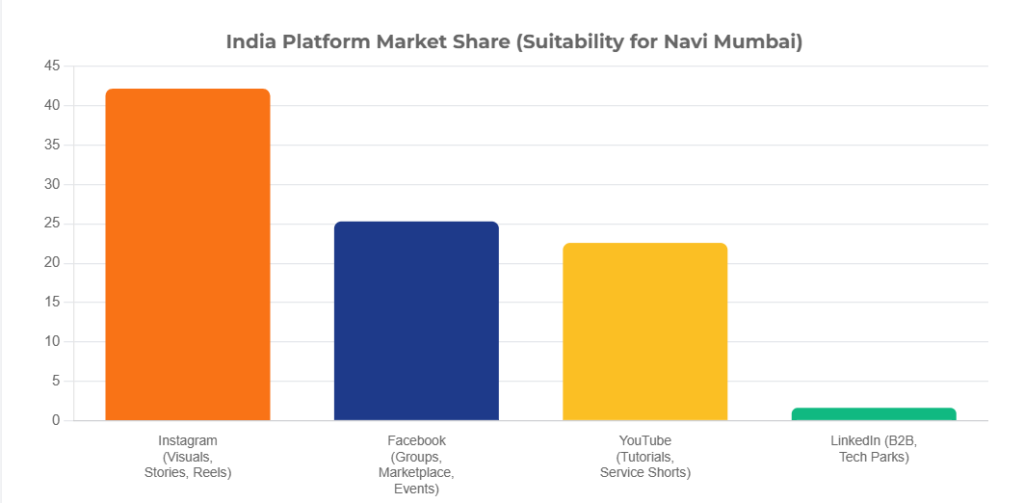
Selecting the right platform is the first critical decision for any small business. In the Indian context of 2026, the dominance of Meta-owned platforms—Instagram, Facebook, and WhatsApp—remains unchallenged for B2C lead generation, while LinkedIn has carved a significant niche for B2B enterprises in Navi Mumbai’s industrial and tech zones.
Social Media Platform | Market Share (India 2026) | Primary Audience in Navi Mumbai | Best Sector Fit |
| 42.19% | Gen Z, Millennials (Vashi, Nerul, Belapur) | Cafes, Boutiques, Gyms, Real Estate | |
| 25.31% | Families, Professionals (Panvel, Kharghar) | Local Events, Community Groups, Real Estate | |
| YouTube | 22.58% | All demographics (Video-first research) | Educational Services, B2B SaaS, Health |
| 1.62% | IT Professionals, Founders (Airoli, Mahape) | Corporate Training, IT Services, B2B | |
| N/A | Every smartphone user in the city | Direct Sales, Follow-ups, Customer Support |
Sources:The effectiveness of digital marketing services in 2026 is measured by the ability to orchestrate these platforms into a single funnel. Instagram and Facebook serve as the discovery layer, while WhatsApp acts as the high-conversion bottom-of-the-funnel tool. For businesses in Vashi and Panvel, the data suggests that allocating 60% of the social media budget to Instagram and Facebook can yield a 25% lift in engagement and a consistent flow of leads [cite: user query context].
The Power of Conversational Commerce and the WhatsApp Funnel
In 2026, WhatsApp has evolved from a messaging app into a comprehensive business infrastructure. For Navi Mumbai small businesses, the integration of the WhatsApp Business API is the single most effective way to reduce lead drop-off rates. Unlike traditional email marketing, which sees open rates around 20%, WhatsApp boasts a staggering 98% open rate, with most messages read within three minutes.
Transitioning to the WhatsApp Business API
While the basic WhatsApp Business app is suitable for micro-enterprises with manual messaging needs, growing businesses must adopt the API to handle scale. The API allows for multiple team members to manage one number, the deployment of intelligent chatbots, and the integration of a searchable product catalog directly into the chat. This transition enables a business to function like a “Digital Munshi”—a term used to describe a structured, automated system that manages inquiries without increasing headcount.
| eature | WhatsApp Business App | WhatsApp Business API (2026) |
| Users | 1 Primary + 4 Linked Devices | Unlimited Multi-Agent Support |
| Automation | Basic Auto-replies | Full Chatbots & Nurturing Flows |
| Broadcasts | Limit of 256 Contacts | Unlimited (Compliance-based) |
| Integrations | None | CRM, Payments, eCommerce Sync |
| Analytics | Basic | Advanced ROI & Attribution |
Sources:The 2026 pricing model for Meta’s messaging platform has shifted to category-based messaging. Marketing messages, such as promotions and offers, carry a specific cost (approx. ₹0.92 per delivered template in India), while service-initiated conversations are often free within certain limits. A key lever for performance is the “72-hour free window” triggered by Click-to-WhatsApp ads. When a prospect initiates a chat through an ad, all messages exchanged for the next three days are free of cost, providing a massive advantage for lead nurturing.
Sources:The 2026 pricing model for Meta’s messaging platform has shifted to category-based messaging. Marketing messages, such as promotions and offers, carry a specific cost (approx. ₹0.92 per delivered template in India), while service-initiated conversations are often free within certain limits. A key lever for performance is the “72-hour free window” triggered by Click-to-WhatsApp ads. When a prospect initiates a chat through an ad, all messages exchanged for the next three days are free of cost, providing a massive advantage for lead nurturing.
Setting Up a High-Converting WhatsApp Catalog
The catalog feature replaces the cumbersome PDF price lists of the past. It provides a visual, mobile-optimized storefront that keeps the shopping journey contained within the chat. For a boutique in Vashi or a specialty store in Panvel, a well-structured catalog is essential.
Step-by-Step Catalog Guidance:
Launch the Catalog Manager: Within the Business Tools section, select “Catalog.” This serves as the central hub for all product listings.
Add Visual Assets: Upload up to 10 high-resolution images per item. It is recommended to use a 1:1 square ratio for consistency and better mobile display.
Optimize Product Detail: Enter names and prices clearly. Descriptions should be benefit-led, focusing on how the product solves a local need (e.g., “Waterproof accessories—perfect for the Navi Mumbai monsoon”).
Organize with Collections: Use sets like “New Arrivals,” “Best Sellers,” or “Ganesh Chaturthi Specials” to guide users toward high-intent categories.
Enable Direct Links: Add a direct checkout or website link for users ready to finalize their purchase immediately.
Hyper-Local Targeting and the Science of Geofencing
One of the primary advantages of digital marketing services in a city like Navi Mumbai is the ability to use geographic precision. Geofencing allows businesses to create virtual boundaries around specific locations, triggering ads only for users within that zone. For a restaurant near Vashi station or a gym in CBD Belapur, this is the ultimate tool for capturing “intent in the moment”.
The Goldilocks Zone of Proximity Marketing
Research suggests that the most effective geofence radius is a “Goldilocks Zone” of 0.25 to 1 mile, or approximately a 5-minute walk from the business location. This radius captures users who are genuinely interested and physically capable of visiting the store immediately, filtering out those who are simply passing through on a fast train.
Strategies for Successful Geofencing:
- The 2-Hour Rule: Messages should create immediate urgency, such as “Grab a free coffee in the next 90 minutes”.
- A/B Testing Locations: Businesses should test different boundaries, such as targeting the entrance of a competitor’s store or a high-footfall railway station.
- Creative Relevance: The ad copy must explicitly mention the location to make the user feel “seen” (e.g., “Hey Nerul, looking for a healthy lunch?”).
- Frequency Capping: To avoid notification fatigue, it is best to limit impressions to 3-4 times per user weekly.
| Targeting Method | Typical Radius | Best for | Expected Engagement Lift |
| Hyper-local (Geofence) | 0.5km – 2km | Cafes, Salons, Retail | 2.8x increase in conversions |
| Node-wide | 5km – 10km | Real Estate, Schools, Gyms | 60% boost in regional visibility |
| City-wide | 20km+ | Multi-branch services, Events | High awareness, broad prospecting |
Content Strategy: Authenticity and the "Lo-Fi" Trend
By 2026, the “aesthetic” and heavily filtered social media feeds of the previous decade have lost their charm. Users are now gravitating toward “lo-fi” content that feels raw, unedited, and authentic. For a small business in Navi Mumbai, this shift is a major advantage, as it removes the need for expensive production crews.
The 40-40-20 Rule for Content Planning
A balanced content calendar is the foundation of consistent lead generation. Digital marketing services recommend a mixture of educational, promotional, and community-focused content to keep the audience engaged without sounding overly sales-driven.
40% Educational Content: This builds authority and trust. For a real estate agent in Panvel, this might be a video on “The impact of the new MTHL on property values in Ulwe.” For a cafe, it could be “The science behind our slow-roast coffee”.
40% Promotional Content: These are the direct lead-generation posts. They must include clear calls to action (CTAs) and direct links to the WhatsApp catalog or a lead form.
20% User-Generated Content (UGC) and Behind-the-Scenes: Sharing customer reviews, photos of patrons at the store, or a video of the staff preparing for the day builds a human connection that polished ads cannot replicate.
Short-Form Video: The Dominant Content Format
Short-form vertical videos—Instagram Reels and YouTube Shorts—have become the primary mechanism for brand discovery in India. These videos generate 2 to 4 times more engagement than static images. The key to success in this format is a strong “hook” in the first 3 seconds to stop the scroll.
Techniques for Effective Hooks:The Bold Statement: “Your social media strategy is already outdated”.
The Relatable Pain Point: “Tired of your ads getting zero clicks?”.
The Statistic: “80% of buyers have decided before they talk to you”.
The Curiosity Gap: “I found a way to double my leads, and it’s not what you think”.
Case Study: Local Success and Failure in Navi Mumbai
The importance of the human touch in social media marketing is best illustrated by contrasting two local establishments. Cafe 70Beans in Vashi has successfully used Instagram to build a loyal community by focusing on the ambiance and the specific culture of Navi Mumbai, resulting in high organic traffic. In contrast, businesses that focus solely on “branding on IG” while ignoring the basics of execution—such as responding to comments and maintaining quality—often struggle to survive in the competitive Navi Mumbai market.
Lessons from Ganesh Chaturthi Campaigns
The 2025-2026 festive seasons saw a massive integration of technology and tradition. Small brands in Navi Mumbai used AI-driven experiences, such as allowing devotees to generate personalized digital images of Ganesha at local pandals. Other businesses used QR-enabled “Digital Diya” initiatives to build massive lead databases of people attending the Lalbaugcha Raja pandals in Navi Mumbai. These examples show that the most successful digital marketing services are those that leverage the emotional power of local festivals like Agri-Koli Mahotsav and Ganesh Utsav to create meaningful touchpoints.
The Small Business AI Stack: 10x Productivity on a Budget
In 2026, the complexity of managing multiple social channels has been significantly mitigated by artificial intelligence. Small businesses can now use a suite of tools to automate content creation and campaign management, allowing them to compete with larger agencies.
| Tool Category | Recommended AI Tools (2026) | Monthly Cost (Approx.) | ROI Window |
| Content Strategy | ChatGPT, Claude, Perplexity | Free to ₹1,700 | Immediate |
| Graphic Design | Canva AI, Adobe Express | ₹500 – ₹800 | 1 – 2 Weeks |
| Video Creation | InVideo AI, Pictory, CapCut | ₹1,250 – ₹1,900 | 2 – 4 Weeks |
| Talking Head Reels | Captions AI, HeyGen | ₹2,400+ | 1 Month |
| WhatsApp CRM | WATI, Interakt, OmniChat | ₹2,000 – ₹5,000 | 2 Months |
Integrating AI into Daily OperationsBusinesses should not view AI as a replacement for human creativity but as a “Digital Assistant” that handles the repetitive work. For example, a restaurant owner can use ChatGPT to generate 30 days of social media captions in minutes, or use InVideo AI to turn a simple recipe script into a high-quality Reel with Hindi narration and local footage. The role of professional digital marketing services in this context is to provide the strategic oversight and high-quality inputs required to direct these AI tools effectively.
Technical Foundations: Pixel, CAPI, and Domain Verification
To run successful paid ad campaigns on Facebook and Instagram, a business must have a robust tracking foundation. Without this, Meta’s algorithm “operates blind,” unable to optimize for the people most likely to convert.
The Step-by-Step Meta Pixel and CAPI Setup
Create the Data Source: In Meta Events Manager, click “Connect Data Sources” and select “Web”.
Generate the Pixel ID: Name your pixel (e.g., “PanvelStore_Main”) and copy the unique Pixel ID.
Choose Installation Method:WordPress: Use a plugin like “Meta Pixel for WordPress” to connect your account easily.
Shopify: Use the native Facebook & Instagram app to sync your data automatically.Manual: Paste the pixel base code into the <head> section of every page on your website.
Implement Conversions API (CAPI): Server-side tracking is essential in 2026 to bypass browser ad-blockers and privacy settings. Without CAPI, you may lose 40% of your conversion data.
Domain Verification: Go to Business Settings -> Brand Safety -> Domains and follow the instructions to add a meta tag to your site’s home page. This ensures your tracking is not restricted by Apple’s iOS privacy policies.
Benchmarking Performance: What Counts as a Good Result?
For a small business in Navi Mumbai, success should be measured against regional benchmarks. The average Cost Per Lead (CPL) varies significantly across industries, and understanding these numbers helps in setting realistic budgets for digital marketing services.
Average CPL Benchmarks in India (2026)
| Industry | Platform | Average CPL (INR) | Monthly Budget for 50 Leads |
| Restaurants / Local Services | Facebook / IG | ₹80 – ₹250 | ₹4,000 – ₹12,500 |
| Healthcare / Clinics | Facebook / IG | ₹200 – ₹600 | ₹10,000 – ₹30,000 |
| Real Estate (Panvel/Ulwe) | Facebook / IG | ₹400 – ₹1,500 | ₹20,000 – ₹75,000 |
| B2B Services (Airoli/Vashi) | ₹600 – ₹2,500 | ₹30,000 – ₹1,25,000 | |
| Education / Coaching | Facebook / IG | ₹150 – ₹400 | ₹7,500 – ₹20,000 |
The ROI EquationBusinesses should reverse-calculate their marketing budget based on their profit margins. If a client generates ₹10,000 in profit, spending ₹1,000 to acquire that customer is a highly logical investment. The typical lead-to-customer conversion rate for Indian SMEs is between 5% and 15%, provided the business has a structured follow-up system in place [cite: user query context].
Influencer Marketing: Micro and Nano-Influencers in Navi Mumbai
In 2026, the focus has shifted from mega-celebrities to micro-influencers (10k-100k followers) and nano-influencers (1k-10k followers). These social media creators consistently deliver higher engagement rates (5-8%) and more genuine audience trust. For a Navi Mumbai business, partnering with an social media influencer who lives in the same node—such as a Vashi-based lifestyle blogger—is far more effective than a generic Mumbai-wide influencer.
Influencer Strategy for SMEs:
Barter Deals: Many nano-influencers are willing to create content in exchange for products or services, making it a cost-effective way to gain visibility.
Product Unboxings and Reviews: Authentic video reviews are powerful tools for building trust with local audiences.
Viral Meme Promotions: Using local humor and slang can help content travel much further within the Navi Mumbai social ecosystem.
Micro-Community Access: Influencers often have access to private WhatsApp or Telegram groups where their recommendations carry significant weight.
Leave a Reply