Meta Ads vs Google Ads: The Ultimate 2026 Guide to Lead Generation for Business Growth
Ekira Marketing | Posted on |
Meta Ads vs Google Ads: The Ultimate 2026 Guide to Lead Generation for Business Growth
The landscape of digital marketing services has reached a historic turning point in 2026. For years, businesses have viewed Google and Meta as the two pillars of online advertising, but the strategies required to succeed on these platforms have shifted dramatically. As we look at the current market, the global lead generation industry is projected to grow from $5.59 billion to more than $32.1 billion by 2035, maintaining a strong compound annual growth rate of 17.2%.
This massive growth is driven by the increasing sophistication of digital marketing services and the need for businesses to find more efficient ways to capture and nurture potential customers. For a digital marketing agency like Ekira Marketing, understanding the nuance between intent-based search and discovery-based social media is no longer just a benefit—it is a requirement for survival in a competitive economy.
In a landmark shift, 2026 marks the first year that Meta is expected to surpass Google in total net worldwide ad revenue, with projections placing Meta at $243.46 billion compared to Google’s $239.54 billion. This change signals that while search intent remains a powerhouse, the ability of social platforms to create demand through algorithmic discovery has become the leading force in the advertising world. For businesses seeking the best digital marketing services, this means the question is no longer “which is better,” but rather “how do I use both to win?” This guide provides an exhaustive analysis of both platforms, offering professional yet easy-to-understand guidance for business owners and marketing leaders ready to scale their lead generation efforts.
The Great 2026 Shift: Why Intent and Discovery Matter More Than Ever
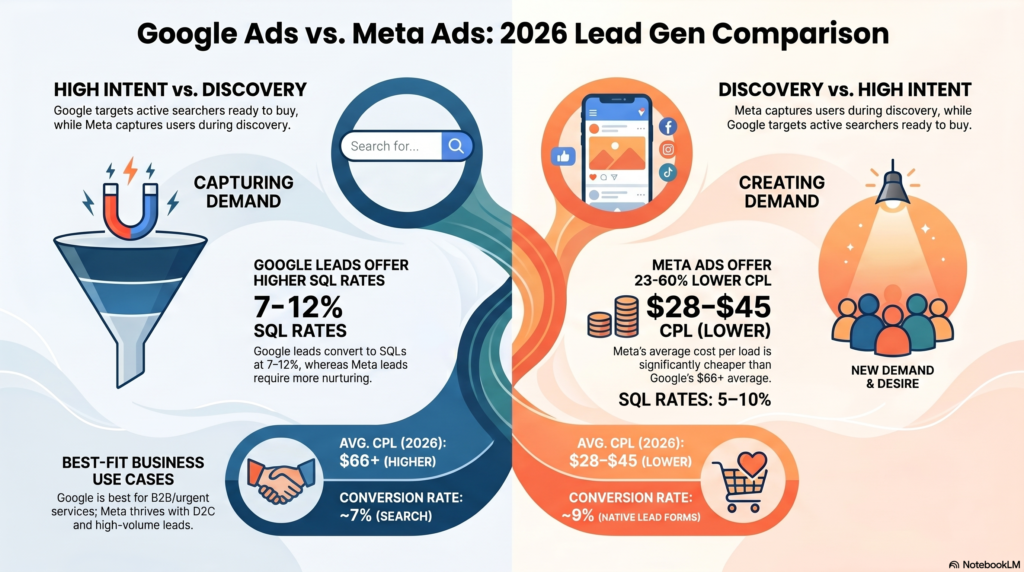
To choose the right path for your business, you must first understand the fundamental difference in how users interact with these platforms. Google is built on a “pull” model. When someone uses a search engine, they are actively looking for a solution to a problem. They have a specific intent, making them high-value prospects who are often ready to buy immediately. This is why Google Ads has traditionally dominated performance advertising; it fulfills an existing need at the exact moment that need is expressed. When a business invests in digital marketing services focused on Google Search, they are essentially bidding for a seat at the table during the customer’s decision-making process.
Meta, on the other hand, operates on a “push” model. Users on Facebook and Instagram are not usually searching for a product or service; they are scrolling through content, engaging with friends, and discovering new ideas. Meta uses billions of behavioral data points—such as how long you watch a video, what your friends are buying, and your recent interests—to predict what you might want before you even think to search for it. This makes Meta an incredible tool for “Demand Creation.” If your business offers a solution that people don’t yet know they need, Meta’s discovery engine is often the most effective way to introduce your brand through comprehensive digital marketing services.
Meta Ads vs Google Ads
The following table provides the foundational comparison between these two giants, highlighting how they serve different parts of your marketing funnel without overlapping their core strengths.
| Aspect | Google Ads | Meta Ads |
|---|---|---|
| User Intent |
High—Active searchers ready to buy |
Medium—Discovery while scrolling |
| Lead Quality |
Superior for bottom-funnel; higher SQL rates (7-12%) |
Good for top-funnel; needs more nurturing (5-10%) |
| Avg. CPL (2026) |
Higher ($66+ cross-industry average) 4 |
23-60% lower ($28-$45 average) 5 |
| Conversion Rate |
Approximately 7% for search campaigns 6 |
Approximately 9% for native lead forms 7 |
| Best For |
B2B, urgent services, high-ticket items 8 |
D2C, brand awareness, high-volume leads 1 |
| Mechanism |
Capturing existing demand 9 |
Creating new demand and desire 10 |
For example, a local plumber in a specialized market would see immediate results from Google Ads because a user searching for “emergency pipe repair” has a critical, immediate need. Conversely, a business offering a new type of fitness coaching would benefit more from Meta’s visual carousel ads, which can spark a desire for a healthier lifestyle in a user who was simply browsing their social feed.
Deep Dive into 2026 Benchmarks: What Does a Lead Really Cost?
In the world of digital marketing services, “Cost Per Lead” (CPL) is the metric that most business owners watch most closely. However, a low CPL is only valuable if the lead eventually turns into a customer. In 2026, we see a widening gap between the costs on Google and Meta, driven largely by increased competition and the sophistication of AI targeting.
On average, Meta Ads deliver leads at a 23% lower cost than Google Ads across most industries. This is because Meta’s inventory is vast, and the platform is highly efficient at finding users who match your customer profile based on their behavior. Google Search, however, has a “ceiling” based on how many people are actually searching for your keywords. Because there is more competition for those high-intent clicks, the price goes up. Businesses utilizing digital marketing services must balance this higher cost against the fact that Google leads are often closer to a final purchase decision.
Industry-Specific CPL Benchmarks for 2026
The following data represents average lead costs across major sectors. These figures are based on the analysis of billions in ad spend and are essential for setting realistic budgets for your digital marketing services.
| Industry | Google Ads CPL (Avg) | Meta Ads CPL (Avg) | Best Platform Focus |
|---|---|---|---|
| Legal Services | $132 | $72 | Google for Intent / Meta for Volume |
| Insurance & Finance | $100 – $160 | $58 – $190 | Google for high-intent search |
| B2B SaaS / Tech | $75 – $208 | $63 – $188 | Hybrid approach is critical |
| Real Estate | $100 | $51.90 | Meta for awareness / Google for buyers |
| Home Services | $53.89 | $34.00 | Google for urgent needs |
| Healthcare | $80 – $162 | $41.60 | Meta for education and awareness |
| E-commerce | $48 | $27.25 | Meta for impulse and discovery |
| Higher Education | $90 | $65 | Meta for long-term engagement |
For a law firm, paying $132 for a lead on Google might seem expensive, but if the average lifetime value of a client is over $12,000, that investment is highly profitable. This is why top-tier digital marketing services always focus on the return on investment (ROI) rather than just the initial cost of the lead.
Mastering the Metrics: How to Audit Your Performance
To run a successful business in 2026, you must speak the language of data. When you work with an agency for digital marketing services, you need to understand the four key metrics that define lead generation health.
1. Cost Per Lead (CPL)
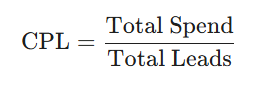
This is the total amount you spend on ads divided by the number of leads you receive. It tells you the efficiency of your current campaign.
Formula:
For a law firm, paying $132 for a lead on Google might seem expensive, but if the average lifetime value of a client is over $12,000, that investment is highly profitable. This is why top-tier digital marketing services always focus on the return on investment (ROI) rather than just the initial cost of the lead.
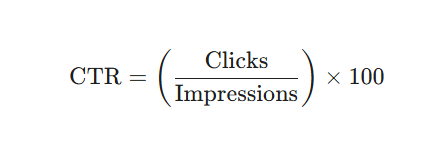
2. Click-Through Rate (CTR)
CTR measures how many people saw your ad and actually clicked on it. It is a direct reflection of how catchy your ad copy and visuals are. In 2026, the average Google Search CTR is about 3.52%, while Meta benchmarks for B2B are often between 0.6% and 1% because people are browsing, not searching.
Formula:
3. Form Completion Rate
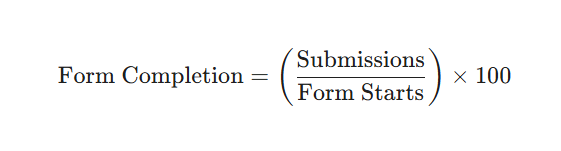
This metric tracks how many people who started filling out your form actually finished it. This is where Meta’s “Instant Forms” shine. Because they keep the user inside the app and pre-fill their information, they often have higher completion rates than external websites. For high-quality digital marketing services, you should aim for a form completion rate of at least 20% [cite: User Query, 35].
Formula:
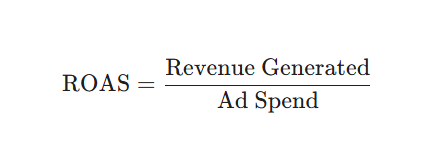
4. ROAS and Lifetime Value (LTV)
This metric tracks how many people who started filling out your form actually finished it. This is where Meta’s “Instant Forms” shine. Because they keep the user inside the app and pre-fill their information, they often have higher completion rates than external websites. For high-quality digital marketing services, you should aim for a form completion rate of at least 20% [cite: User Query, 35].
Formula:
Strategic Pointers: Building a Winning Lead Funnel
Success in lead generation requires a structured approach. Professional digital marketing services don’t just “set it and forget it”; they follow a rigorous process to find the right audience and turn them into customers.
Targeting Your Ideal Audience
In 2026, targeting has moved away from manual “interest” picking and toward AI-driven signals.
On Google: You target based on keywords. If you provide software, you bid on “best CRM software.” This ensures you show up when someone is actively looking for you [cite: User Query].
On Meta: You use “Lookalike Audiences” and pixel data. Meta’s AI looks at your existing customers and finds 3 billion other people who act just like them. This allows your digital marketing services to scale quickly by reaching “cold” audiences that are highly likely to be interested [cite: User Query, 15].
Choosing the Right Ad Formats
The format of your ad can be the difference between a lead and a scroll-past.
Google Lead Extensions: These allow users to submit their info directly from the search result page, removing the need for them to even visit your website.
Meta Instant Forms: These are native, mobile-fast forms that reduce user drop-off by as much as 30% [cite: User Query]. They are ideal for high-volume lead generation because they work seamlessly on smartphones.
One Comment
contact us